Work Packages
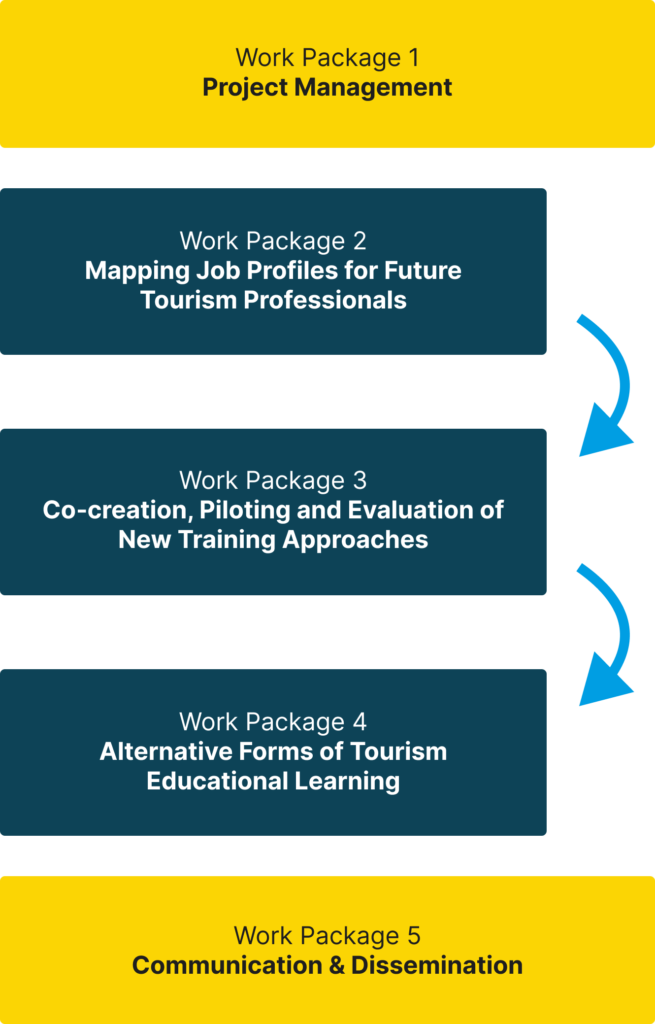
WP1 – Project Management (Lead: HVL)
Ensures effective coordination, governance and quality assurance. Structures regular steering‑committee meetings, partner reporting, risk management, and documentation. Provides the backbone that enables smooth delivery of WP2–WP5.
WP2 – Mapping Job Profiles for Future Tourism Professionals (Lead: TUAS)
Updates proficiency/competence profiles to match green/digital transitions and emerging labour‑market needs. Delivers: (1) a systematic literature review; (2) a Curricula Reform Toolkit with forward‑looking competencies, learning outcomes and key job profiles; (3) an interactive workbook for teachers/developers. Outputs in WP2 directly impacts design choices in WP3 and the topics/skills of the micro‑credentials in WP4.
WP3 – Co‑creation, Piloting and Evaluation of New Training Approaches (Lead: UC)
Runs a design‑thinking sequence—ideation → prototyping → testing → improvement → implementation—together with students, educators, industry and other stakeholders across education levels (pre‑university, HE, lifelong learning). Produces a best‑practice framework and a policy‑recommendation report (incl. micro‑credentials & lifelong learning strategy). WP3 refines and validates concepts originating in WP2 and readies them for scale‑up in WP4.
WP4 – Alternative Forms of Tourism Educational Learning (Lead: BASW)
Designs and implements four stackable micro‑credential courses (with a teacher guide) built on WP2 findings and WP3 pilot insights. Targets both HE students and industry professionals, improving accessibility, flexibility and employability. WP4 is the primary vehicle for mainstreaming innovations into partner curricula and lifelong‑learning offers.
WP5 – Communication & Dissemination (Lead: BASW)
Amplifies reach and impact of WP2–WP4 results via journals, conferences and stakeholder channels (incl. DMOS, companies, and HEIs). Ensures open access to resources and integration of outputs in partner institutions post‑project.