
By Telle Tuominen, Senior Lecturer Marketing and Tourism, Turku University of Applied Sciences
Please note: This is an AI-translated version from Finnish. The original article can be found here.
To cite this article: Tuominen, T. (21.10.2026). Vihreä robotti vai vieraanvarainen ammattilainen? Verkostoista voimaa matkailukoulutuksen uudistamiseen. Talk Journal. https://urn.fi/URN:NBN:fi-fe20261020135520

Hospitality has long been regarded as a core competence in tourism. The European Union wants to accelerate the renewal of the tourism sector and tourism education. Digital and sustainability skills have been placed alongside traditional competences. The EU’s goal is for 80 per cent of the tourism workforce to have received training addressing these changing needs by 2030.
The visitor service journey has been central to vocational tourism education for decades. Guests should feel welcome, and their expectations should be met or even exceeded. By the end of their visit, they should leave with a positive feeling that encourages them to return or recommend the service. This is what we mean by hospitality competence.
As part of this focus on interpersonal interaction, tourism education has also emphasised empathy and good manners. Language and intercultural skills have been an essential part of education because of the sector’s international nature.
First steps towards digitalisation and sustainable development
In the 1990s, tourism programmes introduced skills in reservation systems, tourism product development, sales and marketing. The integration of sustainable development was encouraged, among other things, by the European Commission’s 2001 guidelines on incorporating sustainability principles.
Skills requirements have become more diverse as tourism offerings and target groups have expanded. It is no longer possible to fit every subject into a single degree, which is why curricula now offer more elective options. For the same reason, some programmes have specialised in areas such as accommodation, food services, events or tourism activities, while others have emphasised a broader understanding of service business management.
The twin transition and COVID-19 challenged tourism and tourism education
The announcement in 2020 of the EU strategy to accelerate the green and digital transitions across economic sectors was overshadowed by the simultaneous outbreak of COVID-19. However, the pandemic forced a digital leap: tourism teaching moved onto digital collaboration platforms, while resourceful businesses survived lockdowns by selling virtual experiences, for example.
A couple of years later, the EU published its tourism transition strategy, the Transition Pathway for Tourism 2022–2024, which aimed to support the sector’s recovery from COVID-19, the loss of skilled workers and skills shortages. Another objective was to accelerate the twin transition by encouraging the tourism sector to develop environmentally friendly solutions using digital technologies.
The EU viewed the renewal of tourism education primarily in terms of developing skills for the green and digital transitions. Alongside these, it identified a need to develop soft skills associated with traditional hospitality competence, including language skills, customer experience expertise and intercultural competence. The transition pathway emphasised the flexible updating of curricula in degree programmes, retraining and continuing education.
A new direction for tourism education through collaboration
The EU’s tourism transition pathway relies heavily on the principles of co-creation. A strategy document can only translate into renewal of the tourism sector and its education through the broad involvement of education providers, tourism businesses, administrative bodies, industry organisations and trade unions, among others. The aim is also to engage representatives of other sectors connected to tourism, drawing on expertise across disciplines.
Tourism skills gaps have been examined in several EU projects. For example, a 2024 research publication from the Pantour project, covering more than 20 countries, reported on the skills needs of accommodation providers, food service businesses, attractions, tour operators and destination organisations. These are summarised in the figure by the author of this article, with the visual design created using Microsoft Copilot.
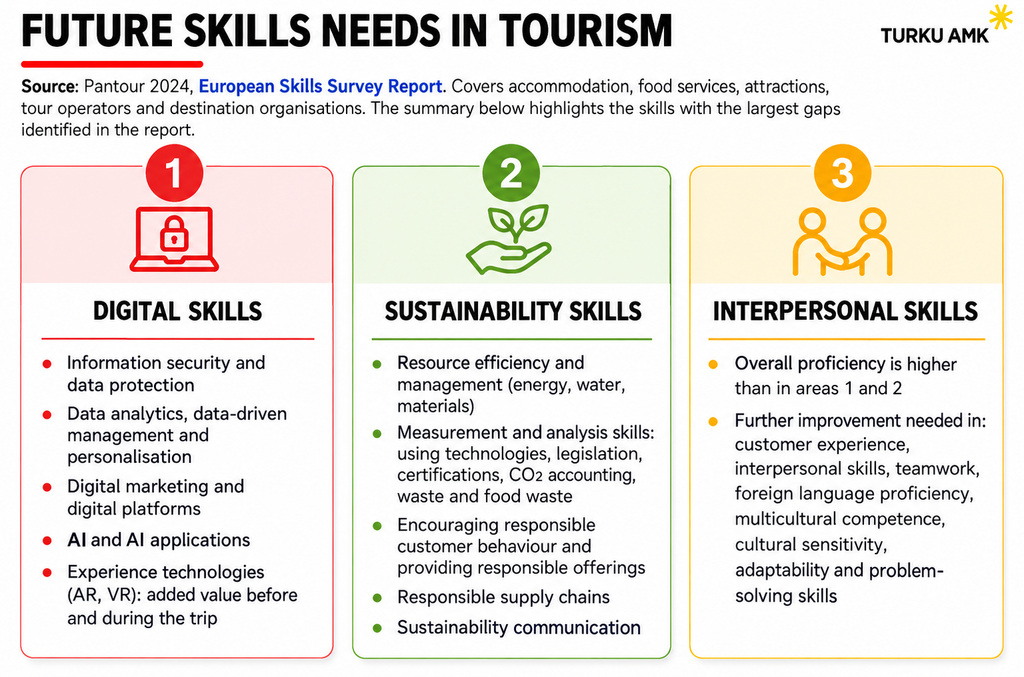
Placing digital, sustainability and interpersonal skills at the heart of tourism education
An example of a project implementing the EU policies described above is the Erasmus+ funded The Future of Tourism Education (TourEdu) project. In this project, educational institutions from Norway, Denmark, Finland and Portugal work with their stakeholders to identify the tourism sector’s skills profiles for the coming years and develop new educational content and delivery methods.
As part of TourEdu’s assessment of future skills needs, representatives of Turku University of Applied Sciences interviewed people in leadership positions across different tourism sectors in Finland during spring 2026. The three competence areas mentioned above—digital, sustainability and interpersonal skills—were considered relevant.
However, a preliminary conclusion emerging from the data was that these competences should not be taught solely as separate subjects, as they are likely to overlap in many ways in the future. The following perspectives raised in the interviews illustrate this:
- 1. Hospitality competence was also considered a future strength of the tourism sector, but interviewees raised questions about how to integrate hospitality into digital interactions. There were also reservations about the role of robots in the hospitality sector. Robots were primarily seen as supporting professionals with routine tasks, helping to address labour shortages and contain staffing costs.
- 2. Connections between sustainability skills, interpersonal skills and technological understanding emerged, for example, in responses concerning water, energy and material efficiency. Tourism leaders and managers are unlikely to be expected to possess in-depth technical expertise in the future. They will, however, need the ability to assess the suitability of technological solutions and their implications for the business, and to make well-founded development decisions.
Building future tourism competences together
The saying “the only certainty is change” also applies to tourism education. Curricula have been updated flexibly in the past, but the pace of change seems to be accelerating. Educational institutions would therefore benefit from developing systematic approaches—partly centralised and partly sector-specific—to anticipating future needs and developing educational content and delivery methods. Projects such as TourEdu can form part of this ongoing development.
Many providers currently offer continuing education for tourism businesses. Greater emphasis should be placed on flexibility, keeping content up to date, continuity between training opportunities and a customer-centred approach. For example, business decision-makers often need different content from employees working directly with customers.
Hospitality, digital and sustainability competences will remain central, yet constantly evolving, areas of expertise. They should be organised into learning units at different levels that can be flexibly combined. At the same time, it is essential to identify how these competence areas overlap in everyday working life.
The relevance, currency and cost-effectiveness of educational content could be strengthened through greater collaboration within the tourism ecosystem and a clearer division of responsibilities between educational institutions when updating learning materials.
Further information
- European Commission, 2022. Transition Pathway for Tourism, available in Finnish as Matkailualan siirtymäpolku. Read the publication.
- European Skills Survey Report. Read the report.
-
A green robot or a hospitable professional? Harnessing networks to renew tourism education
Please note: This is an AI-translated version from Finnish. The original article can be found…
-
🇮🇸 TourEdu in Iceland – two successful contributions to the Nordic Symposium!
What a fantastic few days at the 34th Nordic Symposium on Tourism and Hospitality Research…
-
TourEdu meets in Turku!
🇫🇮 Thank you, Turku! What a week! In September, the TourEdu partners from Turku University…
